


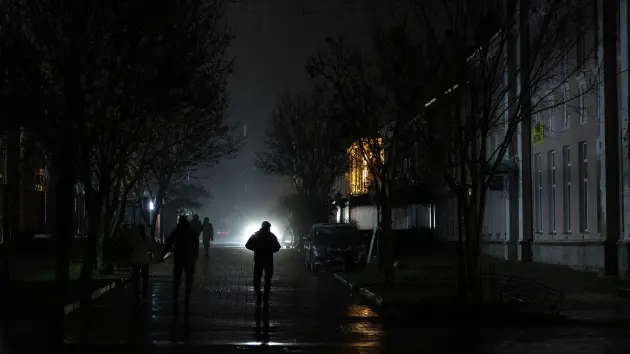
(LONDON) — Millions of Ukrainians have been plunged into frequent darkness and cold as Russian drones and missiles wage a systematic long-range campaign against the country’s energy grid for the fourth consecutive winter.
Even at the offices of Ukraine’s mammoth state-owned Naftogaz oil and gas conglomerate in Kyiv, emergency generators have been keeping the lights on.
“What I can see from my window — there is an absolutely dark city with only some lights,” CEO Sergii Koretskyi told ABC News during a video interview. “I’m sure people recognize this winter as the most difficult since the full-scale invasion started. We can see power cuts from four up to 10 hours a day.”
Russia’s nightly bombardments have increasingly targeted energy infrastructure in recent months, Ukrainian officials say, often involving hundreds of drones and dozens of missiles.
Ukrainian President Voloydmyr Zelenskyy has repeatedly appealed for more Western military aid to help blunt such strikes. “The Russians’ goal is to hurt millions of Ukrainians,” the president said in a social media post on Saturday.
Between October and December so far, Naftogaz recorded 11 “massive attacks on gas infrastructure across Ukraine,” Koretskyi said. “Our gas production infrastructure has suffered significant damage and destruction,” he added.
Naftogaz estimates the combined cost of covering its gas shortfall and repairing its production and storage infrastructure at more than $3 billion, Koretskyi said.
“We can see that the scale and intensity of strikes have changed dramatically,” Koretskyi added. This year’s bombardments have been even more punishing than those in the back end of last winter, he added, when Ukraine had 42% of its domestic gas production knocked out.
Throughout its full-scale invasion — which began in February 2022 following eight years of lower-intensity cross-border Russian aggression — Moscow has denied intentionally targeting civilians or civilian infrastructure.
The Russian Defense Ministry says it attacks Ukrainian fuel and energy targets that support the Ukrainian armed forces and Ukraine’s military-industrial enterprises.
Ukraine is also waging its own long-range strike campaign against Russian energy targets, particularly oil storage and refining facilities. Kyiv says the lucrative proceeds from Russian oil exports help fund Moscow’s ongoing invasion.
Koretskyi declined to say what proportion of the country’s gas production and storage capacities had been taken offline during this winter’s attacks, citing operational security and Moscow’s use of public statements and statistics to guide its strike campaign.
But virtually all of Ukraine’s regions now routinely face rolling blackouts, imposed to help protect the country’s grid while repairs are carried out, leaving millions with only hours of power.
Naftogaz says it supplies gas to 12.5 million households across Ukraine. Around 80% of the population using gas to heat their homes. Each night of Russian attacks threatens new blackouts for tens of thousands and sometimes hundreds of thousands of people.
“Their goal is clear — this is pure terrorism,” he said, “to put us into the darkness without heat during this winter season.”
Analysts have suggested that Western support could prove vital in helping Ukraine through this winter.
“Without substantial Western support — particularly air defense systems, transformers, and financial assistance for emergency repairs — blackouts are likely to be more regular, people will suffer in the cold, and economic activity may slow,” political consultant Kateryna Odarchenk wrote for the Center for European Policy Analysis this month.
Zelenskyy and his top officials have consistently pressed Western allies to provide more air defense systems and ammunition, to help Ukrainian defenders protect civilian centers, military sites and critical infrastructure.
Yuriy Boyechko, the CEO of the Hope For Ukraine charity, told ABC News that the current energy crisis is a result of inadequate air defenses in the face of “the relentless deluge of Russian missiles and drones.” He added, “The only viable solution is immediate, comprehensive air defense support from Western allies.”
The bombing has wrought holes in Ukraine’s energy network. As of December, Naftogaz estimated that Ukraine needed to import 4.4 billion cubic meters of gas through to the end of this heating season — which Ukraine’s government estimates will end by around March 31.
This is expected to cost some €1.9 billion — around $2.2 billion — Koretskyi said. Zelenskyy and his government have mobilized to secure the funding from foreign partners and financial institutions, but Naftogaz’s chief said a hole of around €600 million remains.
Kyiv is turning to private companies in gas-rich nations like the U.S. to help fill the gap. Companies require two permits to export natural gas — one from the Federal Energy Regulatory Commission and one from the Department of Energy.
This year already, more than 500 million cubic meters of American liquid natural gas (LNG) have been imported, with another 300 million cubic meters agreed for import earlier next year.
Through 2026, Koretskyi said, Ukraine would like to bring in another 1 billion cubic meters of American LNG. “We would like to build long-term relationships with U.S. LNG suppliers,” he said.
A recent agreement to import U.S. LNG through the Soviet-era Trans-Balkan pipeline running from Greece is also part of this drive, Ukrainian officials have said.
But as Russia’s attacks grow larger and more sophisticated, the cost and complexity of recovery grows. Naftogaz’s list of equipment needed for repairs is now 190 items strong, Koretskyi said. The estimated cost of this badly needed equipment is more than $900 million, he added.
“There are two lists of equipment — the first one for repairing or replacing those damaged or even destroyed, and the second is for a strategic reserve for upcoming potential attacks,” he explained. U.S. and European suppliers, Koretskyi said, could prove pivotal in filling the gaps.
“The lead time — of production time, delivery and installation — will take between eight and 18 months,” Koretskyi said. “So, we should be ready not just for this winter season, but for the next heating season.”
Meanwhile, the strikes and blackouts continue.
On Dec. 4, for example, the Kherson central heating plant in the southern frontline city was knocked offline after days of attacks by various Russian weapons systems. Kherson military administration head Oleksandr Prokudin said that disruption left more than 40,000 without heat.
“It’s like a nightmare,” Koretskyi said of life under rolling blackouts for many Ukrainians. “I do believe Ukrainians recognize the risk, the challenge, that Russia will continue bombing us.”
“Nobody can imagine what will happen in the coming months or weeks,” he added, suggesting that Ukrainians may have to summon reserves of resilience already tapped by almost four years of full-scale war.
“This is not a sprint, it’s a marathon,” Koretskyi said. “The war changes, upgrades and becomes different every day. The measures for survival, for protection, should be changed as well … That’s how we live.”
Copyright © 2025, ABC Audio. All rights reserved.