

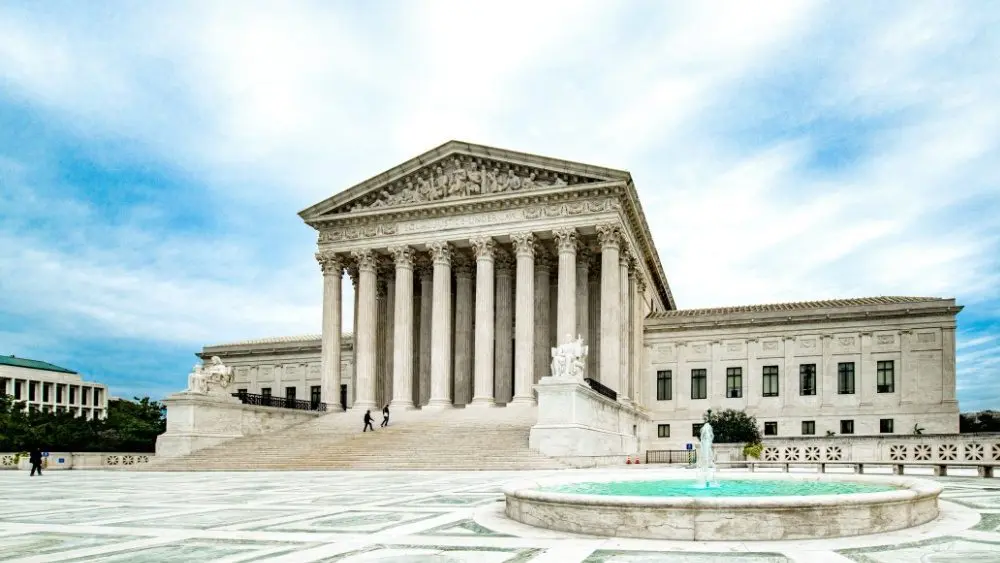
The Supreme Court issued a major decision on Wednesday that significantly limits how race can be used when drawing electoral maps, striking down Louisiana’s congressional district plan and narrowing the scope of the Voting Rights Act in the process.
In a 6-3 ruling divided along ideological lines, the court determined that Louisiana’s revised map—created to comply with Section 2 of the Voting Rights Act—relied too heavily on race and therefore amounted to an unconstitutional racial gerrymander. Writing for the majority, Justice Samuel Alito said that although rare exceptions might exist, this case did not meet the threshold to justify considering race in the redistricting process. Alito wrote: “Because the Voting Rights Act did not require Louisiana to create an additional majority-minority district, no compelling interest justified the state’s use of race in creating SB8. That map is an unconstitutional gerrymander, and its use would violate the plaintiffs’ constitutional rights.”
The case stems from Louisiana’s post-2020 census redistricting. The state initially approved a map with only one majority-Black district out of six, despite Black residents making up roughly one-third of the population. A lower court found that plan violated the Voting Rights Act, prompting lawmakers to create a second majority-Black district in 2024. The Supreme Court, however, ruled that fix unconstitutional as well—this time because race played too central a role.
The ruling forces Louisiana to redraw its map yet again, just weeks before its May 16 primary, and could have ripple effects nationwide. It raises the bar for legal challenges under Section 2, making it harder for minority voters and advocacy groups to contest maps they believe weaken their electoral influence.
Alito emphasized that constitutional protections generally prohibit race-based decision-making, stating that such considerations should be nearly nonexistent in government actions. The majority also pointed to broader societal changes in the South and prior rulings that allow partisan gerrymandering, suggesting states could defend maps as politically motivated rather than racially driven. Concurring, Justice Clarence Thomas argued the decision should “largely put an end” to drawing districts based on race altogether.
However, the court’s liberal justices strongly disagreed. In a dissent, Justice Elena Kagan warned that the ruling weakens a key safeguard against voter discrimination, writing that it “renders Section 2 all but a dead letter.” She added, “Under the court’s new view of Section 2, a state can, without legal consequence, systematically dilute minority citizens’ voting power.”
Voting rights advocates fear the decision could reduce the number of majority-minority districts, potentially leading to fewer elected officials from underrepresented communities. Some experts also believe it may discourage future legal challenges, as proving intentional discrimination—a higher standard emphasized by the court—can be difficult. At the same time, Louisiana officials and the White House praised the outcome. State Attorney General Liz Murrill described the ruling as “seismic,” arguing it confirms that race can only be used in redistricting under very limited circumstances. A White House spokesperson called it “a complete and total victory for American voters,” adding: “The color of one’s skin should not dictate which congressional district you belong in.”
The decision marks the latest in a series of rulings that have chipped away at the Voting Rights Act, following earlier decisions in 2013 and 2021. While a 2023 case briefly reinforced the law, this latest ruling signals a shift toward a stricter interpretation of constitutional limits on race in policymaking.
Editorial credit: Traci L. Clever / Shutterstock.com