

(LONDON) — Iranian Supreme Leader Ayatollah Ali Khamenei on Sunday hit back against U.S. President Donald Trump’s threats of military action in Iran in support of anti-government protests there, shortly before Trump told reporters that Tehran wants “to negotiate” with the U.S.
In a message on his official Farsi-language X account on Sunday, Khamenei posted an image of a crumbling statue with Trump’s likeness.
“That father figure who sits there with arrogance and pride, passing judgment on the entire world, he too should know that usually the tyrants and oppressors of the world, such as Pharaoh and Nimrod and Reza Khan and Mohammad Reza and the likes of them, when they were at the peak of their pride, were overthrown,” Khamenei wrote.
“This one too will be overthrown,” the ayatollah added.
Khamenei’s post came shortly before Trump spoke with reporters aboard Air Force One, first suggesting he may follow through on his threats of new strikes on Iran before revealing that fresh negotiations with Tehran may soon be underway.
Trump said it “looks like” Iran may have crossed the administration’s red line of killing protesters, adding that the U.S. military has “strong options” at its disposal. “We’ll make a determination,” he said.
Trump has repeatedly warned Tehran against the use of force to suppress the protests. On Saturday, Trump wrote on social media, “Iran is looking at FREEDOM, perhaps like never before. The USA stands ready to help!!!”
According to a U.S. official, the president will be briefed Tuesday to review possible U.S. responses to the situation in Iran.
Trump also said Sunday that Iranian leaders contacted him on Saturday and that a meeting is being set up between them. The president cautioned that the U.S. may take action before a meeting takes place.
“They do. They called,” Trump said when asked if he thinks Iran wants to engage diplomatically.
“Iran called to negotiate yesterday — the leaders of Iran called yesterday. They want to negotiate. I think they’re tired of being beat up by the United States,” he said.
“We may meet with them,” he added. “A meeting is being set up, but we may have to act — because of what’s happening — before the meeting, but a meeting is being set up,” Trump said.
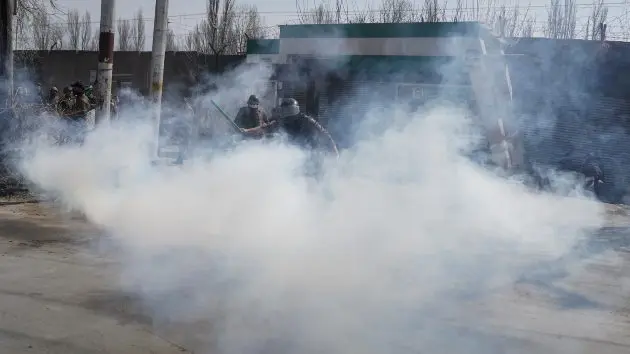
Protests have been spreading across the country since late December. The first marches took place in downtown Tehran, with participants demonstrating against rising inflation and the falling value of the national currency, the rial. As the protests spread to cities across the nation, they took on a more explicitly anti-government tone.
The death toll from the protests had risen to 544 as of Sunday, according to data compiled by the U.S.-based Human Rights Activists News Agency (HRANA).
At least 10,681 people have been arrested, according to HRANA. Protests have taken place at 585 locations across the country, in 186 cities, spanning all 31 provinces, according to activists.
The HRANA data relies on the work of activists inside and outside the country. ABC News cannot independently verify the figures provided by the group.
The Iranian government has not provided any casualty figures for protesters related to the ongoing protests. State television has broadcast images of people attending morgues to identify bodies of friends and relatives.
The state-aligned Tasnim news agency reported on Sunday that 109 security personnel had been killed in the protests.
Widespread and sustained internet outages have been reported across the country amid the deepening protests and reported government crackdown. Online monitoring group NetBlocks said early on Monday that Iran’s “national internet blackout” had surpassed 84 hours.
Khamenei and top Iranian officials have said they are willing to engage with the economic grievances of protesters, though have also framed the unrest as driven by “rioters” and sponsored by foreign nations, prime among them the U.S. and Israel.
Iranian Foreign Minister Abbas Araghchi on Monday described the wave of protests as a “terrorist war” while speaking to foreign diplomats in Tehran.
Araghchi said that the situation is “under control” and that internet access would be restored.
The foreign minister also claimed that Tehran had gathered extensive evidence showing U.S. and Israeli involvement in the protests over recent days. “We believe what took place after 8th of January was infiltration,” he said, suggesting that “Mossad agents” are leading the demonstrations.
Araghchi also criticized Western nations for failing to condemn what he called “terrorists.”
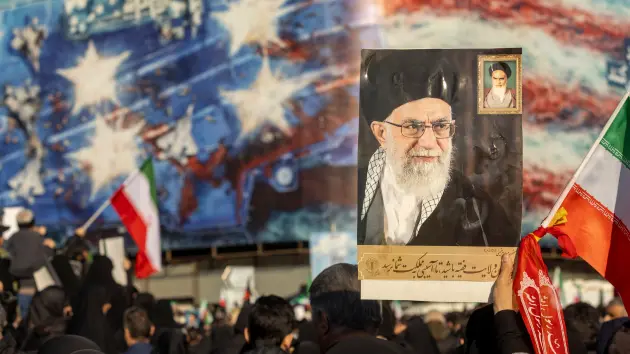
On Monday, state television broadcast footage of pro-government rallies organized in Tehran and other major cities.
The footage showed crowds waving Iranian flags in the capital’s Revolution Square, shouting slogans including “death to America,” “death to Israel,” and “I’d sacrifice my life for the leader.”
State television described the Tehran demonstration as an “Iranian uprising against American-Zionist terrorism.”
Dissident voices abroad, meanwhile, have encouraged further demonstrations. On Sunday, Iran’s exiled Crown Prince Reza Pahlavi addressed protesters in a post to X, announcing what he said was “a new phase of the national uprising to overthrow the Islamic Republic and reclaim our beloved Iran.”
“In addition to taking and holding the central streets of our cities, all institutions and apparatuses responsible for the regime’s propaganda and for cutting communications are to be regarded as legitimate targets,” Pahlavi wrote.
“Employees of state institutions, as well as members of the armed and security forces, have a choice: stand with the people and become allies of the nation, or choose complicity with the murderers of the people — and bear the nation’s lasting shame and condemnation,” he added.
“We are not alone. International support will soon arrive,” Pahlavi wrote.
Copyright © 2026, ABC Audio. All rights reserved.