
(LONDON) — Iranian students from several universities across the country continued protesting on Monday against the Islamic Republic’s regime for the third-consecutive day since Saturday, when schools reopened for the second semester.
Social media videos verified by ABC News show hundreds of students in Tehran, Mashhad and Isfahan shouting slogans, including “Death to Khamenei” and “Woman, Life, Freedom/Iranian Republic,” targeting Ali Khamenei, the supreme leader of the Islamic Republic, and pushing for a regime change.
The protests appear to be the most significant to spread since the Iranian regime’s massacre across the country, in which more than 7,000 people were killed, as the Human Rights Activists News Agency, a U.S.-based group, reported earlier this month. ABC News cannot independently verify the group’s figures.
Groups of students also chanted “Pahlavi will return,” calling for the return of Reza Pahlavi, the U.S.-based son of the former monarch of the country. Pahlavi’s call for protest in early January, 10 days after the unrest started in Tehran, escalated the nationwide protests just before the regime’s crackdown on the protesters.
Pictures of the victims of the January protests have been held by protesting students in universities. A verified video shows students gathering in the Foreign Languages department at the University of Tehran, with some holding pictures of Raha Bohlouli, a student of Italian language and literature at this school who was said to have been killed during the protests.
In a protest at Tehran’s Amirkabir University on Sunday, protesting students were confronted by pro-regime Basiji students who tried to disrupt their gathering.
Following the protests, some students of Tehran’s renown Sharif University who participated received a text message on Monday stating that they have been banned from getting into the university, the semi-official Asriran News Agency reported.
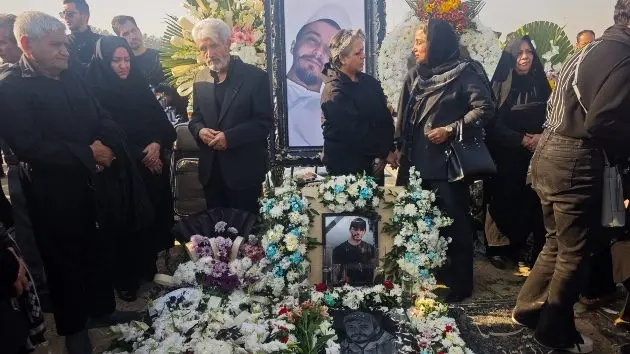
The current round of students’ protests appeared to be gathering momentum as families of thousands of the victims of January’s massacres have recently been holding 40th-day ceremonies in remembrance of their loved ones.
In Iran, one of the significant commemoration ceremonies after someone’s death is held on the 40th day after the burial, when loved ones gather to reflect on the memories of the departed. These ceremonies have traditionally been seen as potential hubs for more protests over the past decades, as the pain and loss of the families have the potential to stir anger and a demand for justice for those killed by the regime.
Dance of defiance
With the broad scope of the Islamic Republic regime’s massacre across the country, thousands of families are still mourning the loss of their loved ones. Iranian cemeteries, holy shrines and mosques — which normally are venues for the 40th-day ceremonies — have turned into scenes of the most extraordinary ways of mourning in the country, as victims’ families have been dancing to mourn as a sign of defiance.
Hundreds of videos circulating online from these ceremonies show parents, children, friends, wives and husbands of the victims dancing to upbeat music playing at mosques and holy shrine sites as a dramatic representation of their grief.
This is seen by many Iran watchers as an act of defiance, transforming a national collective pain into a form of resistance.
Videos show mourning women — even those from traditional and religious backgrounds — dancing in black, many of them without wearing a headscarf.
This comes as mosques and holy shrines have been important bases for the regime to spread the hardcore ideology its leaders stand by, which bans any kind of dance and music and scorns them as sins — let alone tolerating them in public or at holy sites.
The scenes have been witnessed at young victims’ commemoration ceremonies to highlight the happy life they deserved but were deprived of.
“No tears or words can express my pain,” a family member of one of the victims killed during protests in Tehran told ABC News on Friday, speaking on condition of anonymity.
“I always dreamt of dancing at his wedding,” she said. “I felt this burning pain in my chest as I was dancing by the side of his grave. My dream was taken away by a bullet.”
The remerging of the protests comes as the United States and Islamic Republic leaders are preparing for another round of talks in Geneva on Thursday to discuss a possible nuclear deal.
Copyright © 2026, ABC Audio. All rights reserved.